Late Payment Fees in Construction: How to Set Them So They Hold Up

Late Payment Fees in Construction: How to Set Them So They Hold Up

A late payment fee works only if the customer agreed to it in writing before the job started, the amount is reasonable, and the invoice repeats it. Get those three right and you have something you can enforce. Skip one and the fee is a line item the customer ignores. The easier path is to have the terms printed on every estimate and invoice automatically, so nobody has to remember to add them. That is what we built Hechito to do from your voice notes and job photos.
This guide covers what a fair fee looks like, what the contract and invoice must say, when the clock starts, how it differs from delay damages, and what to do when the money still does not arrive.
HechitoKeep Job Details Ready for InvoicingHechito turns voice notes and job photos into organized records, helping contractors manage paperwork from quoting through invoicing.VisitTL;DR
- A late fee is enforceable when the customer agreed to it in writing, in the contract or on the invoice, before work began (Rocket Lawyer).
- Keep it proportionate to your real costs. Courts may refuse to enforce a fee that reads as a punishment (Terms.Law).
- State prompt-payment laws set default interest, commonly 1% to 2% per month, so check your state before you pick a number (ASA 50-state survey).
- Late fees are about overdue invoices. Delay damages are about a job finishing late. They are different clauses.
- Mechanics lien deadlines run from the job, not from the due date, so do not wait on a late fee to start protecting yourself.
Table of Contents
- What counts as an appropriate late fee
- What the state rates look like
- What the contract and invoice must say
- When the fee starts accruing
- Late fees are not delay damages
- The risk of overcharging
- When the fee does not get you paid
- Why chasing by hand costs you
- Our perspective
- Put the terms on every job automatically
- FAQ
- Sources
What counts as an appropriate late fee
No single national number exists. The test courts apply is whether the fee is a reasonable stand-in for the harm of being paid late, such as carrying costs, extra billing time and the cash you could not use. A fee far beyond that can be treated as a penalty and thrown out (Terms.Law).
There are two common ways to write it:
- Interest: a percentage of the past-due balance per month. One commonly cited safe approach is 1.5% per month, or the maximum your state allows, whichever is lower (Sprintlaw).
- Flat fee: a one-time charge triggered by lateness. Terms.Law notes a flat fee and daily interest can both apply if the contract provides for both.
Here is a worked example. You bill $8,000 on net 30 terms with a clause of 1.5% per month on the past-due balance. The customer pays 45 days after the invoice date, which is 15 days late. Interest runs on the overdue part only, so half a month at 1.5% on $8,000 comes to about $60. That is small enough to look fair and still gives the customer a reason to pay on time.
The lesson: a modest, clearly written fee is easier to collect than an aggressive one. Your goal is faster payment, not a bigger invoice.
What the state rates look like
State prompt-payment statutes set default interest for late construction payments. The American Subcontractors Association’s 2024 survey of all 50 states shows typical rates of 1% per month in Alabama, New York and Connecticut, 1.5% per month in Arizona, New Mexico, Tennessee and Montana, and 2% per month on California private projects. Many states also let the winning party recover attorney fees.
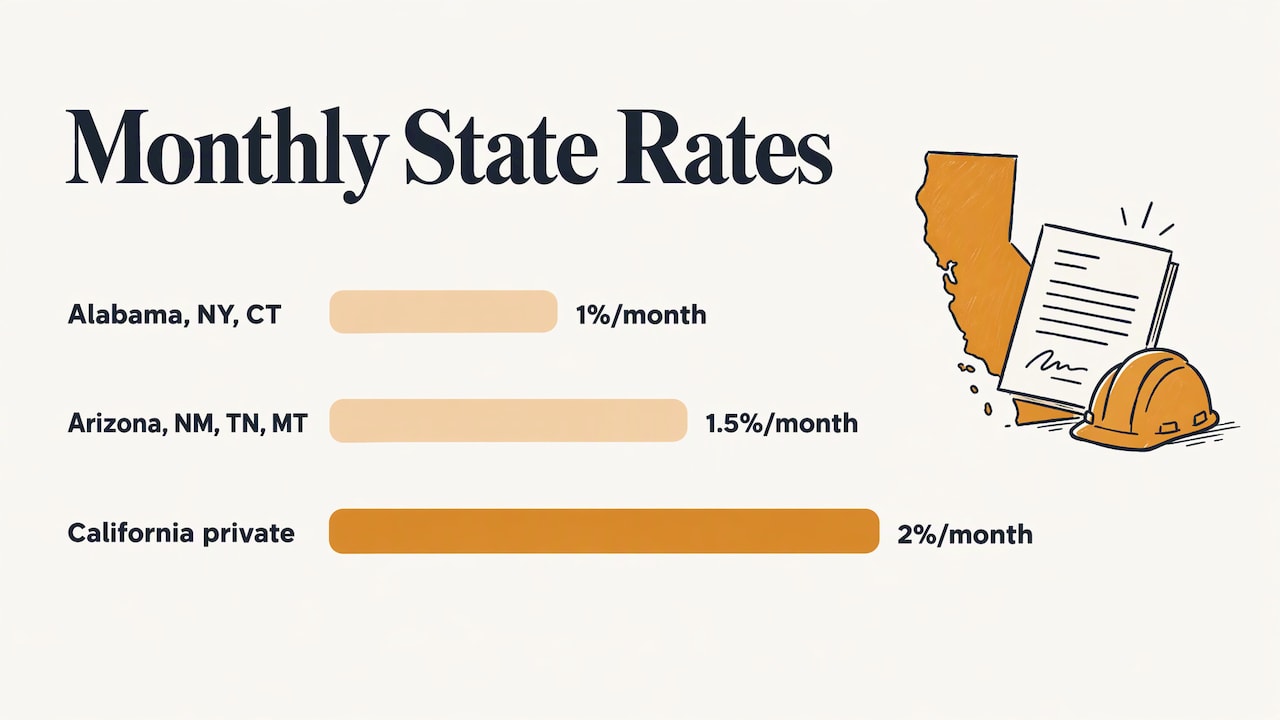
These are defaults and they change with legislation, so treat the survey as a starting map and confirm your own state’s current statute before you write a rate into your terms.
California shows how specific these rules get. According to a 2026 law-firm summary, a private owner must pay progress invoices within 30 days unless the parties agreed otherwise, and may withhold up to 150% of a good-faith disputed amount. Violations carry a 2% per month penalty plus costs and reasonable attorneys’ fees. The same summary says a prime contractor must pay subcontractors within 7 days of receiving a progress payment unless otherwise agreed in writing. For qualifying private non-residential contracts from January 1, 2026 to January 1, 2030, a separate section requires a response to claims within 30 days and payment of undisputed portions within 60 days.
If you work across state lines, do not copy one state’s rate into every contract. Rules differ, and some apply only to residential or only to commercial work.
What the contract and invoice must say
The customer has to know about the fee before the work starts. Rocket Lawyer puts it plainly: the fee can be charged only if the customer agreed to it in writing, in the contract or on the invoice, before work begins. Maryland’s statute shows how strict a state can be. Its commercial law section on late fees allows an agreed late fee, requires disclosure of the amount, the conditions and the timing, and for consumer contracts sets caps and a 15-day wait before the fee can be imposed. That is one state, but it is a good model of what a clean disclosure looks like.
A solid clause covers five points:
- The due date, written in calendar days (net 15, net 30), not “upon completion” or “promptly.”
- The fee, as a percentage per month or a flat amount, in plain numbers.
- The trigger, meaning the day after the due date, plus any grace period. Many businesses allow 3 to 5 days and say so in the payment terms (Rocket Lawyer).
- Signatures from both sides on the agreement.
- A repeat on every invoice, so the terms are in front of the customer when they pay. Nolo’s guidance recommends restating the payment terms and late fee on the invoice itself.
If your terms are unclear or missing, the first thing to fix is the paperwork. Our invoice checklist for payment terms walks through the wording, and the list of invoice errors that delay contractor pay covers what makes customers hold a payment.
On a job site this is where things slip. You agree to terms at the kitchen table, finish a week later and write the invoice from memory at 9 p.m. The late fee clause is the first thing to go missing. Hechito turns your spoken notes and photos into estimates and invoices, so your terms ride along on the document instead of depending on your energy at the end of the day.
When the fee starts accruing
The fee or interest starts the day after payment was due. Under net 30 terms, interest begins on day 31 after the invoice date. If the contract states no payment terms, courts generally treat payment as due on receipt or within a reasonable time, typically 30 days.
Two practical points follow:
- The invoice date matters. If you invoice a week after finishing, your clock starts a week late. Send the invoice the day the work is done.
- Proof of delivery matters. A dated invoice, with photos of the finished work attached, leaves less room for the customer to say they never received it or never accepted the work. Our guide on construction payment schedules and field photos shows how to tie each draw to documented progress.
Late fees are not delay damages
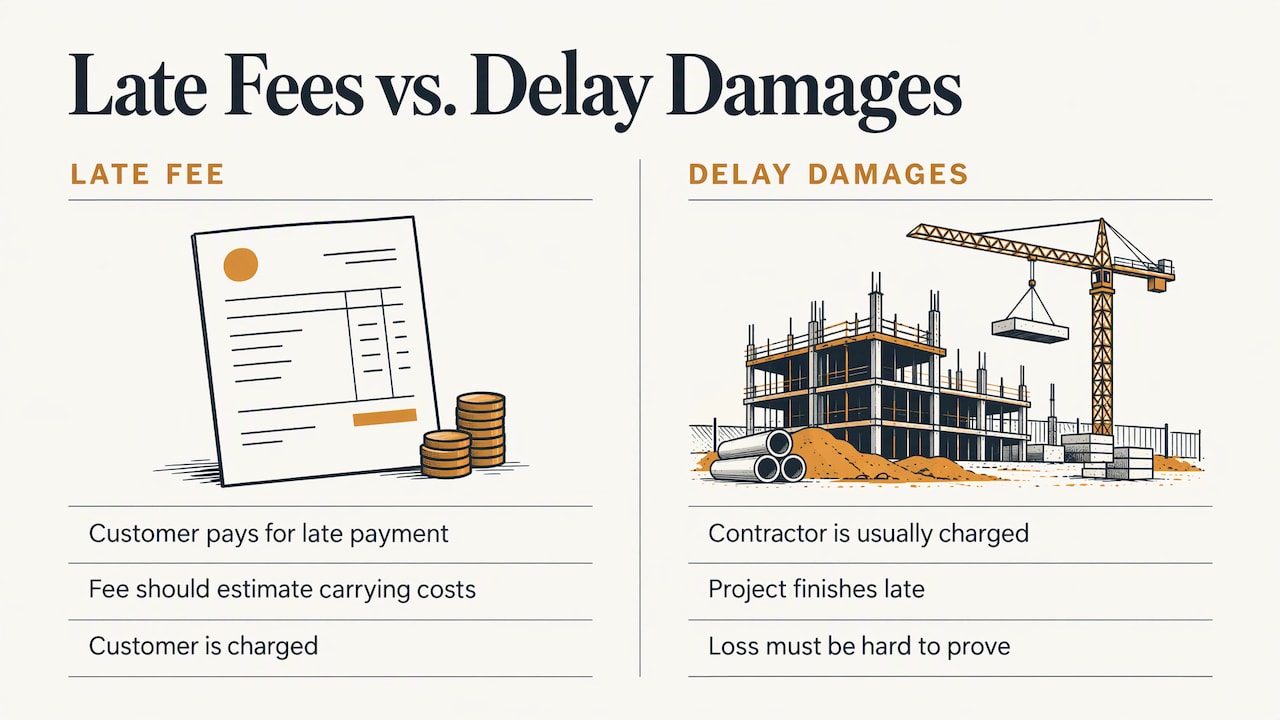
Searchers often mix up two different things. A late payment fee penalizes the customer for paying you late. Liquidated damages or delay costs apply when a project finishes late, usually charged against the contractor. If you are on the paying end of a delay clause, that is a separate contract question.
Courts enforce liquidated damages when the amount is a reasonable estimate of anticipated loss and the loss is hard to prove, following Restatement (Second) of Contracts §356(1). A review of state cases shows Utah upholding a $600 per day highway-delay clause, Montana upholding $500 per day, and Iowa striking down daily clauses in three road contracts as penalties. The same logic applies to your late fee: it has to look like a fair estimate of cost, not a punishment.
The risk of overcharging
A fee that is too high or hidden can backfire. An unenforceable penalty is one risk. An excessive rate can also run into state interest or usury limits, and unclear fees in consumer-facing services can raise Federal Trade Commission Act issues, as Sprintlaw’s contract checklist explains. Keep the number moderate, put it in writing early and make it easy to find. Homeowner jobs deserve extra care, because consumer rules are usually stricter than commercial ones. If a job is large or the rate is above what your state treats as a default, have a construction attorney in your state review the clause once and reuse it.
When the fee does not get you paid
A late fee is leverage, not collection. If the customer still does not pay, work through a sequence:
- Reminder on the due date. Most late invoices are forgotten, not disputed. See our payment reminder email timing and templates.
- A written demand a week or two later, stating the amount, the fee under your contract and a deadline. In California, a demand can start the 30-day clock tied to the 2% monthly penalty under Civil Code §8800, according to the state summary.
- Lien paperwork in parallel. Lien deadlines run from the job, not from the due date. Waiting for the fee to work can cost you the right to a lien. The explainer on how mechanic liens work covers why timing matters, and our own guide to mechanics lien rights lays out what contractors need to track.
- Small claims or an attorney, depending on the amount and your state’s small claims limit. For larger debts a lawyer is the right call, particularly in states where the winner can recover attorney fees.
For the full routine, see our overdue invoice collection plan and the guide to collecting final payment on a job. If you want to understand where your money is stuck first, the invoice aging process shows how to sort invoices by how late they are.
Why chasing by hand costs you
The late fee clause is the easy part. The hard part is enforcing it consistently. Most contractors do not follow up on day 1, day 8 and day 15. They are on a roof or under a sink. So the fee goes unmentioned, the customer learns that late is free, and the next invoice is late too.
Consistency is the point. A reminder that goes out on schedule, with the terms attached and the amount correct, does more than a fee you never mention. That is why we think the fee clause and the follow-up belong in the same system as the invoice. For the reasoning behind that, see how invoice chase automation helps contractors get paid faster.
Our perspective
Most of the late payment problems we hear about from tradespeople are not legal problems. They are paperwork problems. The terms were agreed out loud, never written down, and by the time the invoice went out the details had slipped.
We built Hechito around that gap. You talk through the job and take photos while you are there, and the estimate and invoice come out of what you said, in English or Spanish or both. The follow-up on unpaid invoices is part of the same flow, so the reminder goes out when it should.
Our view is simple: a fair fee, written down before the work starts and repeated on every invoice, beats a large fee you never mention. And the person who should not be typing it up at night is you.
Francisco
Put the terms on every job automatically
Hechito is built for contractors who would rather finish the job than the paperwork. You speak and take photos on site, and Hechito produces the estimates and invoices, sends them, chases payments, and handles receipts and bank reconciliation. It works in English and Spanish, and documents come out in the language your customer needs.
The work is split across virtual co-workers: Chalán for voice quotes and invoices from the job site, Lupita for answering the phone, and Godínez for bookkeeping that matches the bank to your jobs. You can see them all on the crew page, or go straight to Chalán if invoices and payment chasing are your main pain. Plans and prices are on the pricing page.
FAQ
What is an appropriate late payment fee for a construction invoice?
It should be a reasonable estimate of what late payment costs you, not a punishment. Many contracts use interest around 1.5% per month, or the legal maximum if lower (Sprintlaw). Your state’s prompt-payment law may set a default rate, so check it first.
Can I add a late fee after the job is done?
Generally no. The customer has to have agreed to the fee in writing, in the contract or on the invoice, before work began (Rocket Lawyer). Add the clause to your estimate template so it is there every time.
When does a late fee start?
The day after the payment was due. With net 30 terms, that is day 31 after the invoice date (Terms.Law). If you add a grace period, the fee starts after it ends, and the grace period should be written in your terms.
Is a late payment fee the same as liquidated damages?
No. A late fee applies when a customer pays you late. Liquidated damages are a pre-agreed amount for a different breach, most often a project finishing late. Both have to be a reasonable estimate of loss to be enforced (Vaquill).
Sources
- Rocket Lawyer: When to charge late fees on invoices
- Terms.Law: Unpaid Invoice Interest Calculator 2026
- Sprintlaw: Late Payment Clause Checklist For Service Contracts
- ASA: Prompt Payment Laws in the 50 States, rev. 2024
- Construction Laws and Customs: California (2026)
- Maryland General Commercial Law §14-1315
- Nolo: When Am I Allowed to Charge Late Fees?
- Vaquill: Liquidated Damages Enforceability by State
- Understanding Mechanic Liens
Recommended
This is the paperwork Hechito does for you — while you talk.